

As signed in the Paris Agreement, countries have the duty to set out their own goals and plans for the reduction of greenhouse gas emissions. These are referred to as Nationally Determined Contributions (NDCs). However, it was recognised that these plans ran the risk of quickly becoming outdated. Therefore, every five years, every nation renews and strengthens their NDCs, with the next meeting set to take place in November 2021 (Glasgow).
Governments around the world are putting in place new regulations to ensure companies take action and commit to net zero. The UK Government has introduced new regulations to ensure organisations start their Net Zero journeys. One example is the recent introduction of the Public Procurement Notice (PPN) 06/21.
Moreover, the Task Force on Climate-Related Financial Disclosures (TCFD) is expected to be mandatory for large companies soon. This will force those organisations to monitor, analyse and reduce their carbon emissions.
What is Net Zero?
Net Zero can be defined as a target of negating the amount of greenhouse gases produced by human activity. This can be achieved by balancing emissions of carbon dioxide with its removal, implementing methods of absorbing the emissions from the atmosphere.
Demonstrating a commitment to managing your carbon footprint and environmental impact will help to improve your brand image in an increasingly green conscious climate. It can save money through reduced energy consumption and waste costs, improving the overall efficiency of company operations.
You can be ahead of the curve for future compliance requirements, reviewing if your day-to-day activities are sustainable and meet detailed scrutiny. It can improve employee engagement, keeping teams informed of their environmental roles and responsibilities.
1. Measure
In order to understand what steps need to be taken to move towards carbon neutrality, it’s important to firstly measure how much carbon dioxide is actually being thrown into the atmosphere.
There are several things to take into consideration when measuring, such as setting the scope. Broadly speaking, this is where you decide what you’re going to include and what you’re going to emit.
There is also other factors to consider, such as the year, baseline, estimates and target year.
2. Reduce
Once you have measured your carbon footprint, the next step would be to reduce. This means that processes and projects are put into place in order to reduce the amount of emissions that are being generated.
There is currently no standard for what businesses must do, which could lead to confusion over what it really means to be heading towards net zero.
A few things to take into consideration would be budget, type of projects, and how much you will actually reduce your carbon usage by. It’s also incredibly important to ensure that you have a team in place to make sure that the goals you set are being regularly checked and verified.
3. Offset
Offsetting is integral for many in the attempt to achieve net-zero emission goals. With the recent increase in climate-linked disasters, carbon offsetting has sparked a lot more interest.
Offsetting is essentially a way for businesses to compensate for the emissions that they are responsible for and are yet to eliminate. The carbon that you would have absorbed, is instead locked in and essentially trapped from being released back into the atmosphere.
Why should I use a software?
To achieve Net Zero you will need to do a lot of calculations. Calculating your carbon Footprint and monitoring it is one of the most important things as it will help you understand where you stand, and it will set a starting point for your Net Zero journey. That is why it is really important to be accurate with the data collection. Moreover, climate change data is as important as financial data, so it will need to be complete, accurate and timely.
You can collect this data manually, through a consultancy or with a software. Doing it manually is your lowest cost option, but it is easier that you make mistakes or forget some data. Using a software is the best option in terms of cost-time balance. It will require you to enter the data, but top software check if you are missing data or if it is not correct. Moreover, those software contain checklists that will ensure you don’t forget any data.
Using a software will also help you to check which projects are going to be more effectives for you company.
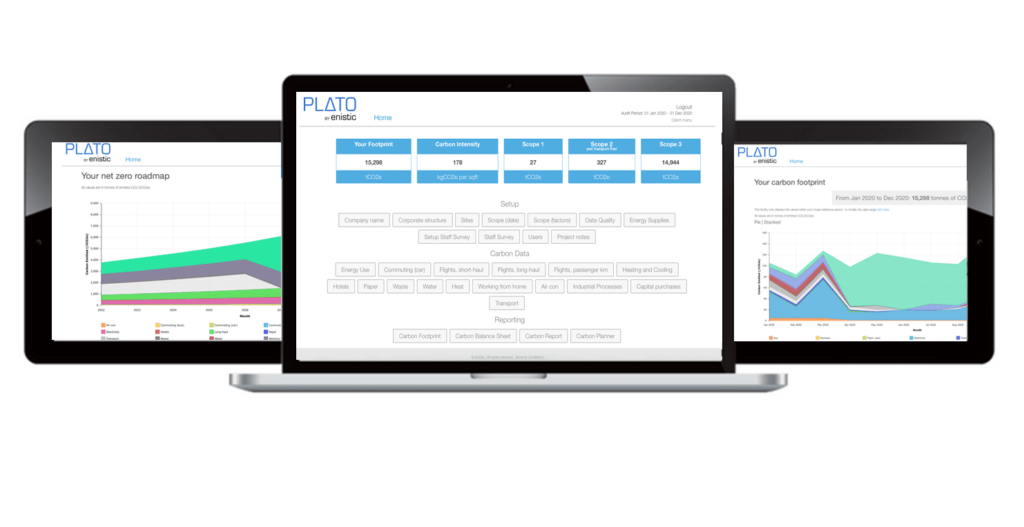
PLATO is the professional cloud-based software that allows you to calculate you Carbon Footprint and monitor it. It has a Carbon Planner integrated that will allow you to create a Carbon Reduction Plan and see the impact of your carbon reduction projects. Moreover, it gives you the opportunity to enhance your company’s energy and cost efficiency through advanced software with the help of our experts.
Book a free consultation
Contact one of our Net-Zero experts today and book a free consultation to see how Enistic can help you set your Net Zero strategy. We will make the processing time and cost-effective. ensuring you move forward, informed, empowered, and confident that you have control.