
A good understanding of your Carbon Footprint will of course help you to manage and reduce it. Demonstrating a commitment to managing your Carbon Footprint and environmental impact will help to improve your brand image in an increasingly green-conscious world. It can improve employee engagement, keeping teams informed of their environmental roles and responsibilities and win you the best new talent. It can also of course save money through the reduction of energy consumption and waste costs, improving the overall efficiency of company operations.
What is your Carbon Footprint made of?
Carbon emissions are divided into three different scopes:
- Scope 1. All direct emissions from the activities of an organisation or under their control (fuel combustion on-site, fleet vehicles, and air-conditioning leaks).
- Scope 2. Emissions created during the production of the energy purchased and used by the organization (UK electricity, heat and steam).
- Scope 3. All other indirect emissions from activities of the organisation originated in sources that they do not own or control (business travel, procurement, waste, and water).
Why is it important to have a good understanding of your Carbon Footprint?
The Government is working on radical new climate change commitments that will set the UK on course to cut carbon emissions by 78% by 2035 and become global leaders in Carbon Reduction.
Consequently, more and more companies are becoming aware they do not really understand their carbon footprint and are seeking advice they can trust on addressing priorities and finding real solutions. The pressure is on, for all the companies across the country, from the biggest to the very smallest. Task Force on Climate-related Financial Disclosures (TCFD), for example, with its impact on investment, affects not only the top 1600 companies in the UK but also the companies further down their supply chain. Therefore, the whole pressure for becoming more sustainable is filtering down to even the smallest suppliers.
Companies simply need to address their sustainability goals. Not understanding your Carbon Footprint is now a threat to commercial liquidity. Beyond legal compliance regulations such as SECR and ESOS, not being aware of your Carbon Footprint leaves you exposed to losing business, as clients are increasingly making decisions based on corporate sustainability. Whether you make a decision to go for Carbon Neutrality due to a genuine wish to contribute to climate resolution or fear of losing key contracts, you need to start working on it.
A few weeks ago, having a good understanding of your Carbon Footprint was still perhaps a luxury, something you could choose to aim for or not. Now, it has become a commercial prerequisite; something that you genuinely need to have, rather than just wanting it.
Why should I use a software?
Calculating your Carbon Footprint is not an easy task. It is really important to be accurate with the data collection. Climate change data is as important as financial data, so it will need to be complete, accurate and timely.
You can collect this data manually, through a consultancy, or with a software. Doing it manually is your lowest cost option, but it is easier that you make mistakes or forget some data. Using a software is the best option in terms of cost-time balance. It will require you to enter the data, but top software check if you are missing data or if it is not correct. Moreover, those software contain checklists that will ensure you don’t forget any data.
Using a software will also help you to check which projects are going to be more effective for your company. You only need to upload all the data to the software and it will do the rest
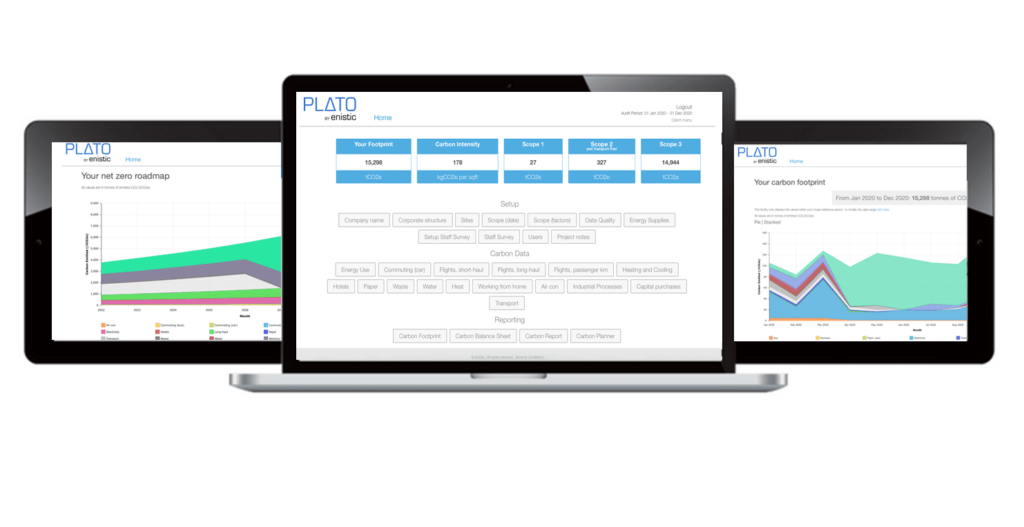
PLATO is the professional cloud-based software that allows you to comply with Sustainability regulations. It is easy to use and you can request help from our team anytime. Moreover, it gives you the opportunity to enhance your company’s energy and cost efficiency through advanced software.