

The NHS Net Zero journey
The NHS supplier roadmap lays out a process towards achieving a net zero healthcare system by 2045.
During COP26 the leaders of more than 10 major NHS suppliers publicly pledged their support for a healthier future by committing to reach net zero emissions by 2045 or earlier.
By 2027 all suppliers will be required to publicly report emissions and publish a carbon reduction plan aligned to the net zero NHS target, for both their direct and indirect emissions.
The NHS is committed to working in collaboration with suppliers to resolve roadblocks along the way and we are continuing to consult on its roadmap with industry partners. This extends to small and medium-sized enterprises and the charitable sector in particular, where the NHS will work hand-in-hand to deliver high quality, sustainable care.
The NHS has also released a roadmap for suppliers, which provides an overview of the milestones that they will be required to comply with.

What is the NHS Net Zero Roadmap for Suppliers?
The NHS uses products from more than 80,000 suppliers, covering medical equipment, food, business and office goods. Over 60% of the NHS carbon footprint comes from the NHS supply chain.
NHS England has approved a roadmap to help suppliers align with its Net Zero ambition between now and 2030. The supplier framework for benchmarking and reporting progress against the requirements has been detailed below.
The Net Zero Supplier Roadmap provides as follows:
- From April 2023 – the NHS will adopt the Government’s ‘Taking Account of Carbon Reduction Plans‘ (PPN 06/21), requiring all suppliers with an anticipated annual contract value over £5m, to publish a carbon reduction plan for their direct emissions.
- From April 2024 – the above will apply for all new contracts, irrespective of value.
- From April 2027 – all suppliers (for any value), will be expected to publish a carbon reduction plan that takes into account the suppliers’ direct and indirect emissions.
- From April 2028 – new requirements will be introduced overseeing the provision of Carbon Footprinting for individual products supplied to the NHS.
- From 2030 – suppliers will only be able to qualify for NHS contracts if they can demonstrate their progress through published reports.
In addition, NHS England will require a minimum of 10% scoring criteria in all procurements to assess how suppliers will contribute to the NHS’s Net Zero targets and social value in contract delivery.
What is PPN 06/21?
The Procurement Policy Note (PPN 06/21) was released by Crown Commercial Service in June 2021 and sets out how government departments need to take account of suppliers’ Net Zero Carbon Reduction Plans in the procurement of major government contracts. It is subject to the Public Contracts Regulations 2015.
Since 30th September 2021, all NHS suppliers who bid for large government contracts (over £5 Million) have to comply with PPN 06/21, detailing their commitment to achieving Net Zero by 2045 and how they will reach the target.
Download the guide for NHS suppliers for details on PPN 06/21, CRPs and compliance requirements.

What is a CRP?
CRPs are to be completed on behalf of NHS suppliers and must meet the reporting requirements, as well as include the supplier’s current Carbon Footprint and its commitment to reducing emissions to achieve Net Zero emissions by 2045.
CRPs will help suppliers and the NHS understand what impact their wider operations have upon the environment. They detail the organisation’s emissions across a single year against a range of emissions sources and greenhouse gases.
Carbon Reduction Plans must be provided by suppliers when responding to in-scope procurements as defined by PPN 06/21. The Carbon Reduction Plan is not intended to replace existing reporting or calculation of your organisational Carbon Footprint. It is a summary document that details high level information that demonstrates your compliance with the measure.
The NHS has adopted the standard for their suppliers, however there are a few differences from the general reporting requirements and the way that they expect suppliers to adhere to it.
Download the Sample Carbon Reduction Plan to make sure you’re on the right track.

What do you need to include in your CRP?
For NHS suppliers, the CRP must include an analysis of:
Scope 1 emissions (gas & fuel)
Scope 2 emissions (electricity)
From April 2027 onwards, suppliers must also submit their scope 3 emissions:
5 Scope 3 emissions (upstream deliveries, downstream deliveries, business travel, commuting & waste)
Within their Carbon Reduction Plan, suppliers must confirm their organisational commitment to achieving Net Zero by 2045 at the latest. This is consistent with the NHS Net Zero supplier roadmap, and will play a significant role in the decarbonisation of the NHS as a whole.
You must also define a base year, establishing your first reporting period. The data collected from the base year is the reference point against which emissions reduction can be measured.
Suppliers’ CRPs should be reviewed and updated annually to reflect changes in organisational structure and to take account of the efforts made to reduce their emissions over time. Suppliers should ensure that the same reporting period is used throughout the submission, to ensure the most accurate and meaningful data can be used in the completion of your Carbon Reduction Plan. To this end your CRP should be reviewed and updated within 6 months of your organisation’s financial year-end.
Your CRP should clearly state that board of directors (or equivalent management body) approval has been given with the date of approval. Where the organisation is a limited liability partnership (LLP), your CRP should be approved by the members. It should clearly state that members’ approval has been given with the date of approval.
Your CRP must be signed off by a director (or equivalent) or designated member (for LLPs). Include their name, job title and the date. You do not need to include a physical signature but you should still clearly state that it has been signed.
How can we help?
To achieve Net Zero you will need to do a lot of calculations. Calculating your Carbon Footprint and monitoring it is one of the most important things you’ll need to do, as it will help you understand where you stand, and it will set a starting point for your Net Zero journey.
That is why it is really important to be accurate with the data collection. Moreover, climate change data is as important as financial data, so it will need to be complete, accurate and timely.
You can collect this data manually, through a consultancy or with a platform. Doing it manually is your lowest cost option, but this does also increase the chance of making mistakes or forgetting bits of your data. For many, using a platform is the best option in terms of cost-time balance. With the Enistic Platform, you are required to enter the data, with the software automatically checking if you are missing data or if it is not correct.
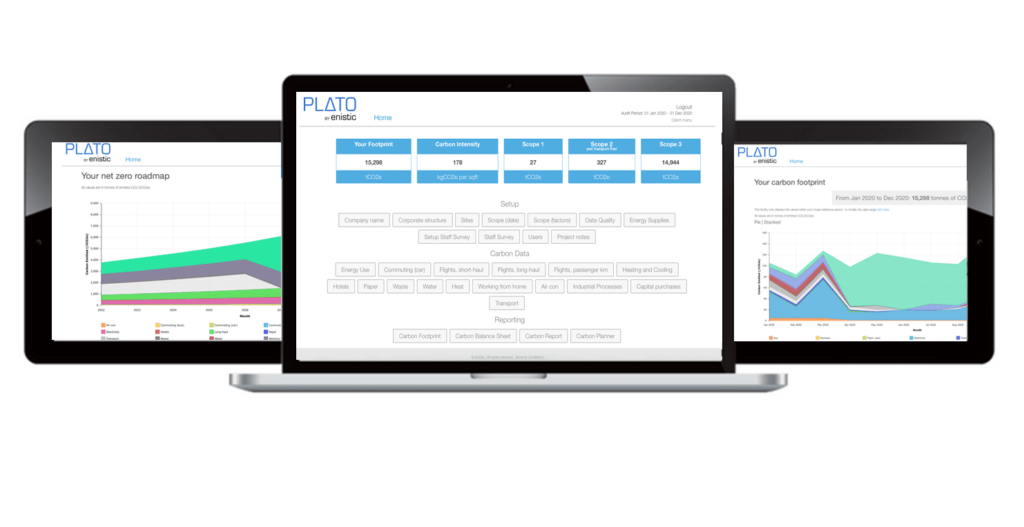
The Enistic Platform is the professional cloud-based software that allows you to calculate your Carbon Footprint and monitor it. It has a Carbon Planner integrated that will allow you to create a Carbon Reduction Plan and see the impact of your carbon reduction projects. Moreover, it gives you the opportunity to enhance your company’s energy and cost efficiency through advanced software with the help of our experts.
Book a free consultation
Contact one of our Net-Zero experts today and book a free consultation to see how Enistic can help you set your Net Zero strategy. We will make the processing time and cost-effective. ensuring you move forward, informed, empowered, and confident that you have control.