

What’s the mission?
“The effects of poor air quality and climate change are already being seen in our GP practices, and in our hospitals, and it is absolutely right that we are part of the solution.
But we can’t do this alone, which is why it is so important that we throw down the gauntlet today to our suppliers too.”
Amanda Pritchard
Chief Executive of NHS England and NHS Improvement
30 September 2021
While the NHS can modify the way it consumes goods and services to reduce carbon emissions, part of their supply chain emissions can only be reduced by the suppliers themselves. This is the focus of the “end of the decade commitment” to “no longer purchase from suppliers that do not meet or exceed our commitment to net zero.”
The NHS is optimally placed to drive a greener, fairer and more equitable health economy. They plan to use their collective purchasing leverage to catalyse innovation in med tech, partner with suppliers who deliver on their Net Zero commitments, drive transparency to eliminate modern slavery, and facilitate local economic growth.
By 2045, we see an NHS with a Net Zero, fair, and transparent supply chain.
Their mission is, working in partnership, to create world-leading responsible procurement practices that deliver on the NHS Supply Chain Net Zero targets and drive transparency and social value through NHS spend.
So what exactly are their goals for this year and the next?
What is Net Zero?
Achieving Net Zero means that your company produces zero carbon dioxide emissions by balancing emissions against carbon emission reduction, and carbon offsetting strategies.
Demonstrating a commitment to managing your carbon footprint and environmental impact will help to improve your brand image in an increasingly green conscious climate.
It can save money through reduced energy consumption and waste costs, improving the overall efficiency of company operations.
You can be ahead of the curve for future compliance requirements, reviewing if your day-to-day activities are sustainable and meet detailed scrutiny.
It can improve employee engagement, keeping teams informed of their environmental roles and responsibilities.


Priority Goals for NHS Supply Chain
A key priority for the NHS this year is to remove an additional 2,900 tonnes of carbon from their own supply chain. They plan to do this by mapping their Scope 3 emissions from their highest carbon emitting supplies and products. They will then work with supply partners and the NHS on reduction plans to help reduce those to the minimum levels.
This means that the NHS will require data from their suppliers in order to gain the insight into their Carbon Footprint that they would like. At the moment, there are many Trusts that are struggling to identify and track their Scope 3 emissions because their suppliers are just not in the position to be able to track them. This could be for a variety of reasons, one being a lack of understanding/urgency. The NHS has recognised that their suppliers are all on a different level when it comes to their sustainability journeys, with some already leaders in the field, and those that have no clue where to start.
For those with no clue, the best thing to start off with is your Carbon Reduction Plan, which is based on the PPN 06/21 standard. Want to know more? Learn more on our NHS Suppliers Net Zero Compliance page.
Publishing your Carbon Reduction Plan will eventually become mandatory in order to be an NHS Approved Supplier, but why wait until that point? With the current situation only getting worse, the sooner we can get our act together, the better.
The NHS is also committed to removing the further 190 tons of single-use plastics from their supply chain during this year by reducing the amount of plastic in high
content plastic containers, introducing more sustainable alternatives across their catering consumables product range. As well as this, they plan on introducing a new framework to deliver clinical waste containers as a service.
For NHS suppliers that are currently using single-use plastics, it’s clear that it’s in your best interests to align your services with the goals that the NHS has set itself. For suppliers that would like to partner with the NHS in the future, it’s clear what actions you need to take in order to be recognised as a viable partner.
They will continue to offer circular economy initiatives, which include utilising remanufactured and recycled products. Their procurement teams are working hard to identify more of these opportunities. The NHS has therefore made it very clear that they would like nothing more than to find suppliers that understand their long-term goals, as well as recognise that there is no time to waste. By starting your sustainability journey now, you’re definitely increasing your chances of forming valuable partnerships in the future.
It’s not just about ticking a box. You are encouraged to go above and beyond, showing a real commitment to the situation that not only the NHS is in, but the whole world.
In this financial year, the NHS will require a further 500 suppliers operating in those markets to complete modern slavery assessments and a further 500 suppliers to complete the labour standards assessment.
Their human rights and labour standards pillar also includes their commitment to embed social value in all that they do. A social value weighting 10 to minimum will be required across all future tenders, as well as continuing to ensure 33%, as the minimum, of spend remains with small and medium-sized enterprises.
As a carbon consultancy that has worked with a number of large suppliers over the years, we’ve seen the mistakes and pitfalls that businesses find themselves in when it comes to compliance. One of those mistakes is leaving too little time. The sooner that you start to track your emissions, the more accurate your data and Carbon Footprint will be. This will also be more beneficial for the Trusts that you’ll partner with, as in turn, their data will also be more complete.
NHS Evergreen Sustainable Supplier Assessment
The supply chain is responsible for 62% of the NHS Carbon Footprint Plus, with medicines, chemicals, and equipment alone accounting for 38% of all emissions. Business services, construction and freight, and food and catering are also significant contributors.
The Evergreen Sustainable Supplier Assessment will be the mechanism for suppliers to engage with the NHS on the requirements of the NHS Net Zero supplier roadmap, providing a unique and consistent way for suppliers to demonstrate their leadership in sustainability, and share their Net Zero targets and progress with the NHS.
The NHS is actually currently piloting the assessment with a number of suppliers. The pilot will provide the NHS with an opportunity to test the self-assessment tool in the online Atamis procurement portal and provide early feedback prior to launch next year.
How Does This Affects You?
There are big changes coming to the way that the procurement process works with the NHS. Priorities and requirements are changing and if you want to be exceeding your competitors, the best thing you can do is get on board now.
Many suppliers are minimally concerned about the Carbon Reduction Plan requirement, since the supplier roadmap does not require this to be mandatory until 2024, however the biggest opportunity to reduce NHS Supply Chain’s impact on the environment comes from understanding the Scope three emissions of its suppliers and products.
Start now. Get your Carbon Reduction Plan going, work with a third party company (like us) and understand your emissions. By taking these actions, you’ll be able to map out your Carbon Footprint, as well as obvious opportunities where you can make reductions and become a more sustainable supplier.
Why should I use a software?
To achieve Net Zero you will need to do a lot of calculations. Calculating your carbon Footprint and monitoring it is one of the most important things as it will help you understand where you stand, and it will set a starting point for your Net Zero journey. That is why it is really important to be accurate with the data collection. Moreover, climate change data is as important as financial data, so it will need to be complete, accurate and timely.
You can collect this data manually, through a consultancy or with a software. Doing it manually is your lowest cost option, but it is easier that you make mistakes or forget some data. Using a software is the best option in terms of cost-time balance. It will require you to enter the data, but top software check if you are missing data or if it is not correct. Moreover, those software contain checklists that will ensure you don’t forget any data.
Using a software will also help you to check which projects are going to be more effectives for you company.
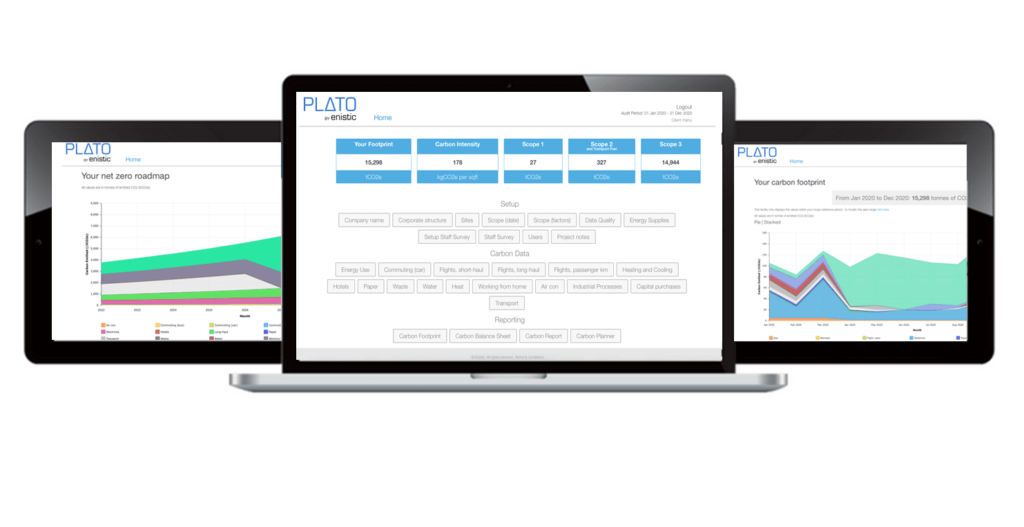
Enistic is the professional cloud-based software that allows you to calculate you Carbon Footprint and monitor it. It has a Carbon Planner integrated that will allow you to create a Carbon Reduction Plan and see the impact of your carbon reduction projects. Moreover, it gives you the opportunity to enhance your company’s energy and cost efficiency through advanced software with the help of our experts.
Book a free consultation
Contact one of our Net-Zero experts today and book a free consultation to see how Enistic can help you set your Net Zero strategy. We will make the processing time and cost-effective. ensuring you move forward, informed, empowered, and confident that you have control.