
 A few weeks ago, having a good understanding of your Carbon Footprint was still perhaps a luxury, something you could choose to aim for or not. Now, it has become a commercial prerequisite; something that you genuinely need to have, rather than just wanting it.
A good understanding of your Carbon Footprint will of course help you to manage and reduce it. Demonstrating a commitment to managing your Carbon Footprint and environmental impact will help to improve your brand image in an increasingly green-conscious world. It can improve employee engagement, keeping teams informed of their environmental roles and responsibilities and win you the best new talent. It can also of course save money through the reduction of energy consumption and waste costs, improving the overall efficiency of company operations.
Enistic is helping companies to manage their Carbon Footprint and finding the best ways of reducing it through rigorous data analysis now.
Why is it important to have a good understanding of your Carbon Footprint?
As announced earlier this week by the UK Government, following the recommendations of the government’s Statutory Climate Advisors, the deadline to become Carbon Neutral has changed. The Government is working on radical new climate change commitments that will set the UK on course to cut carbon emissions by 78% by 2035 and become global leaders in Carbon Reduction. Moreover, it has been announced that for the first time, international aviation and shipping will be included in climate law.
Consequently, with the change of deadlines, more and more companies are becoming aware they do not really understand their carbon footprint and are seeking advice they can trust on addressing priorities and finding real solutions. The pressure is on, for all the companies across the country, from the biggest to the very smallest. Task Force on Climate-related Financial Disclosures (TCFD), for example, with its impact on investment, affects not only the top 1600 companies in the UK but also the companies further down their supply chain. Therefore, the whole pressure for becoming more sustainable is filtering down to even the smallest suppliers.
Companies simply need to address their sustainability goals. Not understanding your Carbon Footprint is now a threat to commercial liquidity. Beyond legal compliance regulations such as SECR and ESOS, not being aware of your Carbon Footprint leaves you exposed to losing business, as clients are increasingly making decisions based on corporate sustainability. Whether you make a decision to go for Carbon Neutrality due to a genuine wish to contribute to climate resolution or fear of losing key contracts, you need to start working on it.
What is your Carbon Footprint made of?
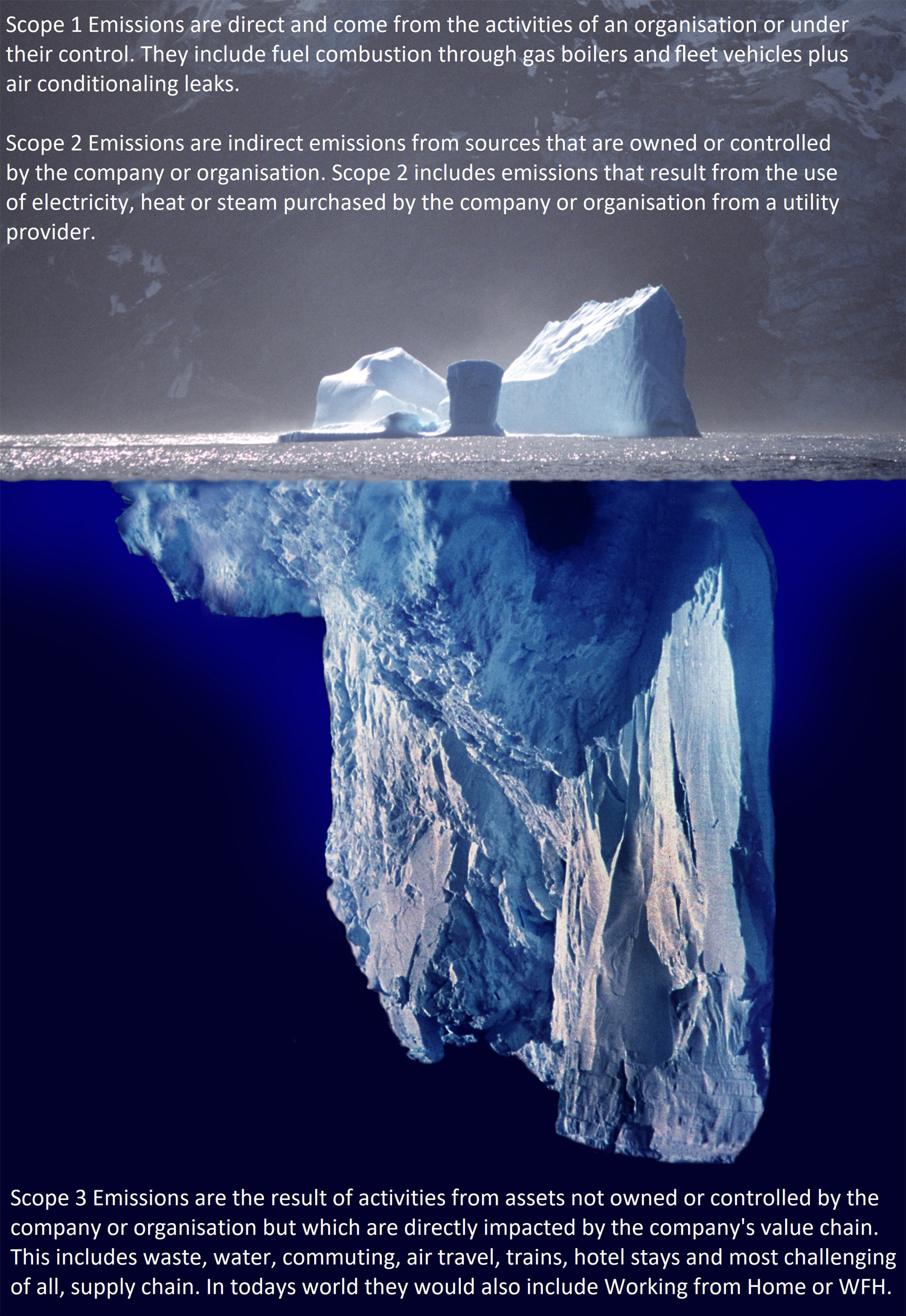
Carbon emissions are divided into three different scopes:
- Scope 1. All direct emissions from the activities of an organisation or under their control (fuel combustion on-site, fleet vehicles, and air-conditioning leaks).
- Scope 2. Emissions created during the production of the energy purchased and used by the organization (UK electricity, heat and steam).
- Scope 3. All other indirect emissions from activities of the organisation originated in sources that they do not own or control (business travel, procurement, waste, and water).
Four steps to reduce your Company’s Carbon Footprint.
 Simple energy-saving projects. Start with basic actions such as changing the old light bulbs for LED lights and making sure that all employees switch off their computers and screens before going home. In this step, the goal is to reduce the amount of energy you are using.
- Capital-intensive energy-saving projects. At this point, you will need to invest in bigger energy-saving projects such as installing solar panels and changing your heating system to a more efficient one. Those projects cost more money, but they will give you big savings in your energy use.
- Green energy adoption. You can take this step at the start, it’s completely up to you; all you need to do is move into green energy suppliers. Make sure your energy comes from a sustainable green source by asking for proof that it is green energy.
- Carbon offsetting. Pay to compensate for the carbon emissions you cannot reduce or eliminate. Different schemes across the world can offset your carbon emissions by planting trees, providing clean cooking solutions, or protecting native lands for wildlife and indigenous people. Carbon offsetting will also be an important part of your Corporate Social Responsibility (CSR) program.
How can I reduce my Carbon Footprint?
At Enistic we provide proven, science-based, custom carbon-net-zero plans over 1, 3, and 5 years. We are committed to helping you understand your Carbon Footprint and to find the best ways for reducing it and make your company more energetically efficient.
Following our effective 7-step plan, we can help you to reduce your Carbon Footprint by building a carbon zero strategy:
- Outline clear objectives and a timeline. We will ask you what your goals are and we will help you to plan SMART objectives. It is important that those goals are aligned with your company’s mission and vision.
- Measure and manage your emissions data. We will ask you to provide us with all the data we need to calculate and analyse your energy consumption and Carbon Footprint. We know that not all companies have time to fill out the data forms, which is why we also offer the option to do it for you. Just provide us with the electricity, fuel, gas and transport bills.
- Make plans for long-term impact and benefit. We want to ensure that all Carbon Footprint reduction plans are as time and cost-effective as possible to help you establish the best strategy for your company. We will work with you to set long-term objectives towards Carbon Footprint reduction and we will estimate your future savings.
- Always work to the best-practice standard. Enistic has been helping thousands of companies throughout the world to reduce their energy use and Carbon Footprint ever since 2002, and we are proud of our work and services. Enistic’s aM&T solution and systems are Carbon Trust Approved. We are a Carbon Trust Accredited Supplier and a member of ESTA.
- Establish carbon reductions you can manage prior to carbon offsetting. We will assist you to set up the most suitable changes regarding simple energy-saving projects, capital-intensive energy-saving projects, and green energy adoption. These projects and changes will be based on our thorough analysis of your energy consumption and Carbon emissions.
- Ensure your offset projects meet detailed scrutiny. We know that some companies that offer offset projects, take your money but do not use it to carry out these projects. We will ensure that all the Carbon offsetting projects we suggest are the best for your company, making sure they have accreditations such as the Gold Standard certification.
- Full and transparent reporting. We will create a report with our analyses of your data and we will present you your Carbon Neutrality plan. We value honesty and transparency. We will tell you how much it will cost and also how much you are going to save. We hope you find our solutions beneficial and together we can achieve your goals.
Whatever your motivation to become Carbon Neutral is, we can help you to make a genuine impact and make the process as painless as possible.
Want to get a better understanding of your Carbon Footprint and how to reduce it?
Contact one of our lead assessors today and book an appointment to see how Enistic can help make the process as time and cost-effective as possible ensuring you establish the best strategy for your company.