

Scope 1, 2 and 3 emissions is a way of categorising the different kinds of GHG emissions your business creates due to its own operations, as well as in its wider value chain.
In order to reduce the carbon footprint of your business, you must be able to track and measure your carbon emissions. In order to do this, you need to look across your entire business – the three different scopes help you do this, as well as break down the emissions into separate categories.
Whilst it may seem a little daunting at first, the different scoping categories help you to identify your total emissions based on everything that it takes for you to operate your business.

Scope 1
Scope 1 emissions relate to the fuels you burn directly. This could include gas from company cars, fuel used to power your equipment or something similar. So long as you pay the fuel bill or own the asset, your business has scope 1 emissions.
Scope 2
Scope 2 emissions are indirect GHG emissions associated with the purchase of electricity, steam, heat, or cooling. Although scope 2 emissions physically occur at the facility where they are generated, they are accounted for in an organisation’s GHG inventory because they are a result of the organisation’s energy use.
Scope 3
Scope 3 emissions are the result of activities from assets not owned or controlled by the reporting organisation, but that the organisation indirectly impacts in its value chain. Scope 3 emissions include all sources not within an organisation’s scope 1 and 2 boundary.

Scope 1 Carbon Emissions – Examples
Relates to all direct emissions from the activities of an organisation under their control. This includes:
- Natural gas use
- Other fuels
- Bioenergy
- Refrigerants and other gases (air-conditioning)
- Fuel used in Company owned passenger vehicles
- Fuel used in Company owned delivery vehicles
Scope 2 Carbon Emissions
Includes indirect emissions from electricity purchased and used by the organisation. Emissions are created during the production of the energy and eventually used by the organisation. Considerations for scope 2 are:
- UK electricity
- UK electricity for electric vehicles
- Heat and steam generation
Scope 3 Carbon Emissions
Includes all other indirect emissions from the activities of the organisation, occurring from the sources that they do not control. Scope 3 emissions are usually the greatest share of a company’s carbon footprint, covering emissions associated with business travel, procurement, waste, and water. Included are:
- Water supply
- Water treatment
- Waste disposal
- Well to Tank (WTT) fuels
- WTT – Bioenergy
- WTT – UK electricity
- WTT – Heat and steam
- Transmission and distribution
- UK electricity transmission and distribution (T&D) for electric vehicles
- Material use
- Business travel -Air & WTT
- Business travel – Sea & WTT
- Business travel – Land & WTT
- Commuting – Land & WTT
- Delivery vehicles and freight + WTT
- WTT for company owned vehicles
- Hotel stays
- Managed assets – Electricity
- Managed assets – Vehicles

As a result, Scope 3 typically represents the greater part of a company’s total emissions. There is growing pressure on companies from potential investors, shareholders, clients, partners, and even staff, to fully understand their Carbon Footprint including Scope 3, and how this works throughout their value chain.
Understanding your full Carbon Footprint will allow you to make informed decisions for the future, reduce your impact on the planet and minimise the commercial risks to your company created through a lack of transparency or ignorance of your Carbon burden. Although Scope 3 emissions could well represent the majority of your GHG emissions, reducing them is possible once you understand their source.
Please note that the NHS is already looking at their emissions and will be searching for sustainable partners and suppliers.
Why should a company measure its Scope 3 emissions?
Demonstrating a commitment to managing your carbon footprint and environmental impact will help to improve your brand image in an increasingly green conscious climate.
It can save money through reduced energy consumption and waste costs, improving the overall efficiency of company operations.
You can be ahead of the curve for future compliance requirements, reviewing if your day-to-day activities are sustainable and meet detailed scrutiny.
It can improve employee engagement, keeping teams informed of their environmental roles and responsibilities.
Why are Scope 3 emissions the most difficult to report?
Since businesses have less control over their scope 3 emissions and how they are addressed, this makes it difficult to both track and reduce them.
What you can do is offer to collaborate with suppliers on solutions to help reduce the emissions produced, or even consider making changes to your supply chain.
Whilst this should be helpful, you should also encourage your suppliers to further reduce their emissions through their own purchasing decisions and manufacturing processes.
For NHS Suppliers, there are existing frameworks such as PPN 06/21 compliance that requires them to produce a carbon reduction plan. This plan highlights their targets for carbon reduction as well as how they plan to get there.
Carbon reduction projects can include a variety of actions that help the company make permanent reductions, which they can track and monitor the process of.
[/et_pb_accordion_item][/et_pb_accordion]
How can we help?

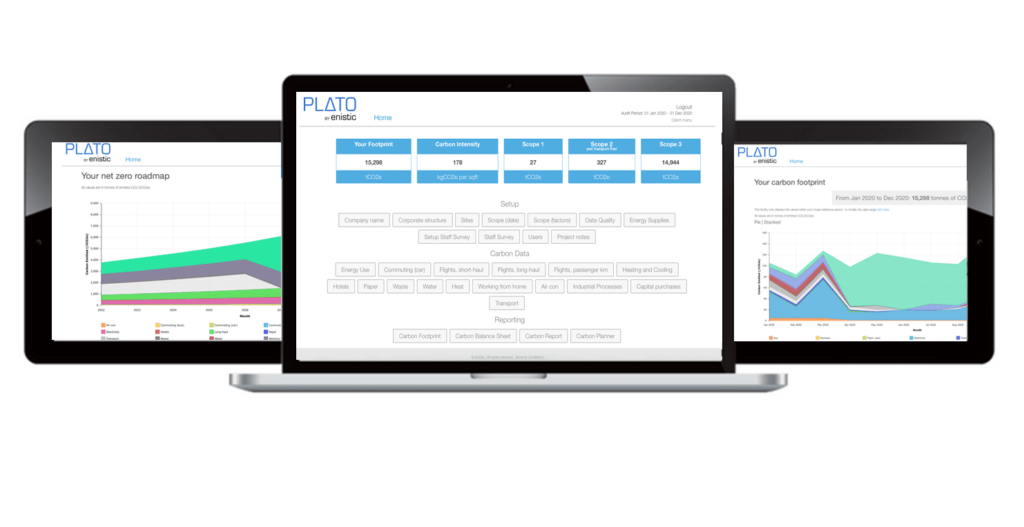
With our carbon management platform, you can easily generate an accurate and real-time carbon footprint, as well as develop realistic Carbon Reduction Plans.
Our platform analyses and controls carbon and energy data in real-time across unlimited sites with unlimited user access. It facilitates the measurement, reporting, and management of an organisation’s carbon emissions.
It’s also the backbone of our carbon and energy management services. It allows our clients to much better understand when and where their carbon consumption is going with its easy to interpret dashboards and reports. It enables carbon and energy waste to be identified and to better manage consumption, leading to average savings of 28%.
You can also save time by uploading your data straight onto the platform, or let us worry about the data collection for you. Once your data is uploaded, you can generate various reports, including the all-important PPN 06/21 report. Once our experts have reviewed the report, you can download it in an editable format, so you can customise it and share it with your colleagues.
We can help you with your Scope 1, 2 & 3 emissions, ensuring that you’re working up the ladder on the Sustainable Supplier Framework.
It’s all down to you and your needs. We understand that every supplier needs something different, which is why we adjust our platform to meet your needs.
The Ensitic Platform can be accessed anytime, anyplace, anywhere with your own personal and secure login.
Book a free consultation
Contact one of our Net-Zero experts today and book a free consultation to see how Enistic can help you set your Net Zero strategy. We will make the processing time and cost-effective. ensuring you move forward, informed, empowered, and confident that you have control.